
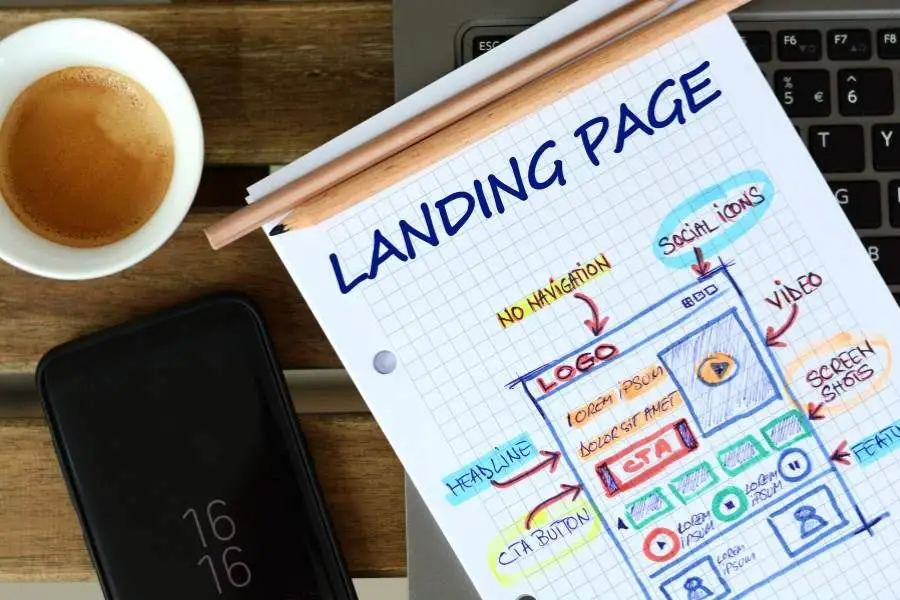
You’ve set the budget, written the ads, and picked the keywords. Clicks are coming in. Leads aren’t. And every click still costs money, whether the visitor sticks around or not.
When that happens, the ad usually isn’t the problem. The page is. In most underperforming campaigns, the drop-off traces back to a handful of fixable landing page mistakes, and none of them show up as an error message. They just drain the budget one bounce at a time.
This guide covers the five mistakes that do the most damage, explains how landing page quality affects what you pay per click, and finishes with a pre-launch checklist you can run in about 30 minutes. For a small business running ads, landing page optimization is one of the cheapest ways to lower cost per click and improve return on investment without raising spend. It’s also one of the most overlooked pieces of digital marketing for small businesses.
How Your Landing Page Affects What You Pay Per Click
Google Ads grades your keywords with a Quality Score from 1 to 10. It’s built from three components: expected click-through rate, ad relevance, and landing page experience. That last one is entirely about where you send people.
In practice, landing page experience is mostly about user experience. Google judges it on things like how relevant and useful your content is to the search, how easy the page is to navigate (including on mobile devices), how quickly it loads, and how open you are about who your business is and how to reach you.
Quality Score itself is a diagnostic number, but the same quality signals feed into Ad Rank during every auction. Ad Rank decides whether your ad shows, where it appears, and what you pay. A competitor with a stronger page can outrank you while bidding less, which means you can pay more for a worse position simply because your page underperforms. Flip that around, and a stronger page improves your page visibility in paid results without a higher bid.
So your landing pages hit your ad budget twice, in two different metrics:
- Before the click: Weak page quality can raise your cost per click and push your ad lower.
- After the click: A weak page has a lower conversion rate, so every lead or sale costs more.
Fixing the page is one of the few changes that improves both numbers at once. That’s why landing page optimization belongs at the start of your optimization strategy, not the end.
5 Landing Page Mistakes That Waste Ad Spend
These problems show up on landing pages of every size, from local service businesses to national ecommerce brands. Each one is a common landing page optimization gap, and each one is fixable without a full rebuild.
1. Slow Load Times
Paid visitors are impatient visitors. Every second before your page content appears gives potential customers a reason to hit the back button after you’ve already paid for the click. Page speed issues usually come from oversized images, heavy page design themes, and extra scripts.
Test the exact ad URL in Google’s free PageSpeed Insights, and aim for a Largest Contentful Paint of 2.5 seconds or less. Faster page performance helps SEO and organic page visibility too. Speed is the first user experience problem anyone notices.
2. A Headline That Doesn’t Match Your Ad
If the ad promises “Same-Day Water Heater Repair” and the page says “Welcome to Smith Plumbing,” people may assume they’re in the wrong place. Repeat the ad’s offer in your headline and carry the same value proposition from ad to page. Persuasive copy starts with confirming the click, not your company history.
Tight message match is one of the simplest ways to increase conversions from clicks you’re already paying for. Not sure which headline wins? That’s a job for A/B testing.
3. Too Many Choices on One Page
A landing page has one job: getting visitors to take one desired action. Navigation menus, social links, and competing offers all give potential customers a way out. Distraction-free design means removing any page elements that don’t support the conversion and using one clear call to action, repeated down the page.
Keep the page copy focused on a single offer. Simple page design isn’t lazy. It’s focused, and it helps increase conversions.
4. Clunky Mobile Layouts
Mobile best practices start with thumbs, not cursors. A page layout can technically fit mobile devices and still be frustrating. Tiny buttons, pop-ups that cover the screen, and a call to action buried far down the page all push up your bounce rate. Mobile optimization is a user experience issue, so open the live ad on your own phone and try to convert before anyone else does.
5. Forms That Ask for Too Much
The form is where lead generation succeeds or fails, and every extra field lowers your conversion rate. Ask only for what you need to follow up, usually a name, contact info, and one qualifying question.
Make the button say what happens next, like “Get My Free Quote,” and add social proof, like a star rating, beside it. Short forms generate leads more efficiently. Need more detail?
Try a two-step form and use split testing to compare it against the short version.
What High-Converting Landing Pages Have in Common
Whether the goal is lead generation or online sales, high-converting landing pages that generate leads consistently share a few page elements:
- Persuasive copy and a clear value proposition that speak to the target audience’s problem before talking about the business
- Trust signals like reviews, licenses, guarantees, and client logos
- Social proof near the decision point, including customer testimonials with real names
- A clean page layout that guides the eye from headline to offer to call to action
- Honest urgency and scarcity, like a real deadline, never a fake countdown timer
These best practices hold up across industries. Good page design and a smooth user experience support the message instead of competing with it.
Your Pre-Launch Landing Page Checklist
Before you launch a campaign or send another dollar to your landing pages, run through this list. Run it on your existing landing pages too. It’s landing page optimization at its simplest.
Message and Offer
- The headline repeats the main offer from the ad.
- The value proposition is clear on the first screen.
- The page copy speaks to one target audience, not everyone.
- Every section points toward the same desired action.
Speed and Mobile
- A mobile page speed test shows a good or near-good LCP.
- Page elements like video and chat widgets don’t slow the page or pull focus.
- You’ve tested the live URL on your own phone, start to finish.
Focus and Trust
- Main navigation and outbound links are removed.
- Trust signals and social proof, like customer testimonials, sit near the form or button.
Form and Tracking
- The form asks only for what you need right now.
- A test submission reaches the right inbox or CRM.
- Conversion tracking fires correctly in Google Ads, Google Analytics, and any other analytics tools you use.
After Launch: Test, Measure, and Keep Improving
Landing page optimization isn’t a one-time task. It’s an ongoing optimization process guided by real user behavior.
Start with a few core metrics in Google Analytics or your other analytics tools:
- Conversion rate by device (if mobile lags, revisit mobile optimization first)
- Bounce rate for paid traffic specifically
- Cost per lead, the number that matters most for lead generation
- Page performance scores after any design change
- Where people stop scrolling, using a free heatmap tool like Microsoft Clarity to see user behavior directly
Then use A/B testing on one element at a time: the headline, the page copy, the call to action wording, or form length. Keep notes so your optimization strategy builds on itself. Split testing two versions against the same traffic shows what actually moves conversion rate. Give every A/B testing experiment enough traffic to reach a confident result before you pick a winner.
Treat your landing pages as one step in a larger conversion funnel. The ad attracts the right person, the page turns interest into action, and your follow-up turns that action into revenue.
Fix the Page Before You Raise the Budget
When a campaign underperforms, the instinct is to spend more or rewrite the ads. But if your landing pages load slowly, break the ad’s promise, or make your target audience work too hard, more traffic just means more waste.
None of these best practices are complicated. Fix them first, build landing page optimization into your regular optimization process, and every dollar you put into digital marketing has a better chance of becoming a real return on investment. That’s how you increase conversions and turn more visitors into customers.
For help optimizing your landing pages, contact Mandzok Marketing today.
